
Friday Morning Brief May 29, 2026

Member Spotlight
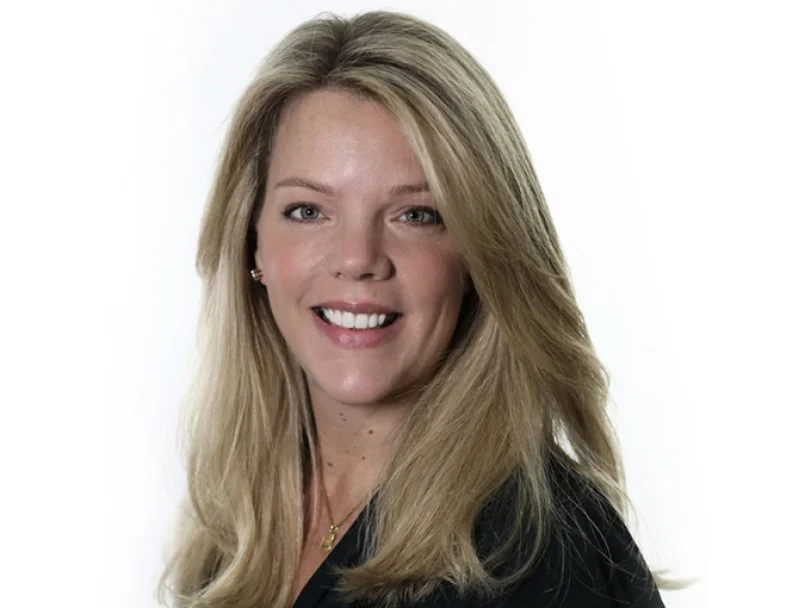
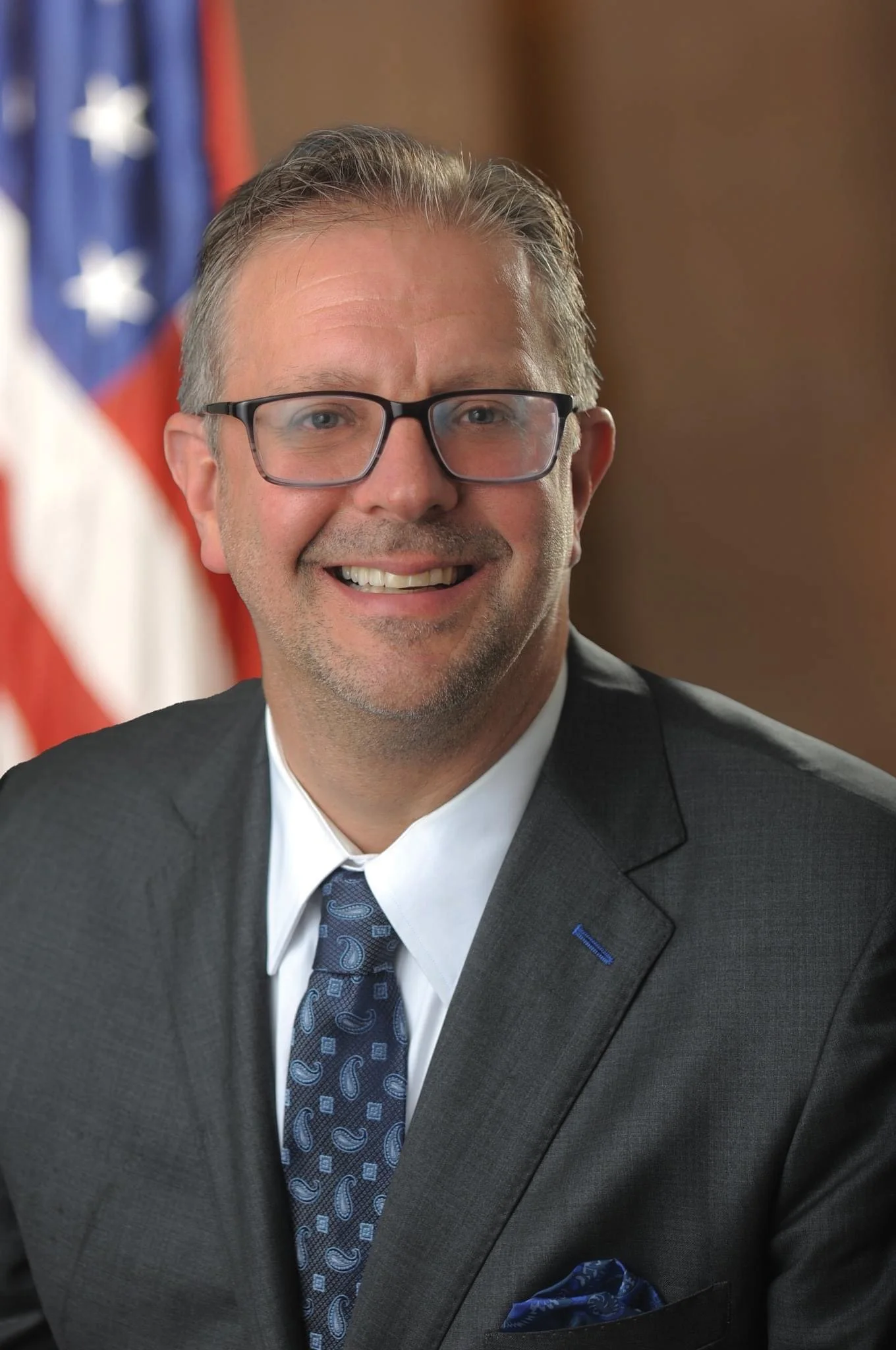
Senator Alexis Weik
Senator Alexis Weik joins us to discuss her district, priorities, and some of the work she has done in the Senate on behalf of her community. Before being elected to the Senate, she was a small business owner in her community and served in public service as a Receiver of Taxes for the Town of Islip, where she assisted the community taxpayers and improve the office's efficiency. Currently she serves as a Ranking Member of various committees, including on Civil Service and Pensions, Local Government, and Women's Issues. She is also a member of Senate committees on Education, Social Services, and Veterans, Homeland Security & Military Affairs.
What district do you represent?
I represent the 8th senate district, which covers part of Nassau County on the south shore and part of Suffolk County on the south shore, including parts of Fire Island.
What are some landmarks that are in your district?
Fire Island Light House, Robert Moses State Park, Connetquot State Park, Heckscher State Park, Bayard Cutting Arboretum, Fire Island from Kismet to Sea View, and Lake Ronkonkoma.
What's your favorite music/genres/artists?
I love music so I enjoy a huge variety of genres and artists. My current playlist includes Green Day, Maris, Chappell Roan, Chris Stapleton, Lee Brice, Queen, Van Halen and lots of others. I danced ballet for most of my youth, so there are lots of classical artists that I just love. Sitting around the firepit I will typically listen to 60-70's folk music because it's just kind of fun to listen to.
Any favorite NY sports teams?
The Yankees
What was your profession/background before being elected to the Senate?
I have a BA in Business, and I have been a certified Personal Trainer for 18 years. I have worked at a variety of businesses, ranging from Fortune 500 to Mom-and-Pop companies. I was a legislative aid for Suffolk County Legislator Tom Cilmi, and the Deputy Receiver of Taxes for the Town of Islip. I was the elected Receiver of Taxes for the Town of Islip for over nine years before I was elected to the Senate.
What were some of your priorities for this year?
Pushing back against legislation that takes away from our personal freedoms, and, of course, working hard to fight back against the endless increases to our cost of living here in New York, caused by bad legislation passed by the current majority in the state.
What are some local specific issues you worked on?
Securing funding for Oakdale Merge, making sure we paused the electric school bus mandate, working with DOT to make the Fire Inlet Bridge safe and funded for maintenance, and ensuring our local volunteer firefighters get the state funding they need.
My office has also been focused on hosting events to assist as many constituents as possible. Some of our most popular recent events have included Shed the Meds, to get unused drugs out of our homes and prevent abuse and overdose, Narcan training to save people from overdose, and food drives benefiting our local food pantries. Additionally, our Stop the Bleed events with the Suffolk County Sherrif's Office and Emergency Preparedness events with NYS Homeland Security and Emergency Services have been highly informative.
What advice would you give young college students who want to get more involved in politics?
First, get involved in your community. Work to understand the world around you, especially the world outside of your comfort zone. Do not tune out others even if you disagree with them - take the time to walk in their shoes and understand their perspective. No one person is ever 100 percent right and no one person is ever 100 percent wrong. The best solutions always lie somewhere in the middle.
Are you a public official or staffer that would like to be featured in our spotlight? If so, reach out to your favorite D&A team member or contact us at team@dickinsonavella.comto set up an interview!
Aung Hset/D&A
Lawmakers Pass FY2027 Budget 58 Days After April 1st Deadline
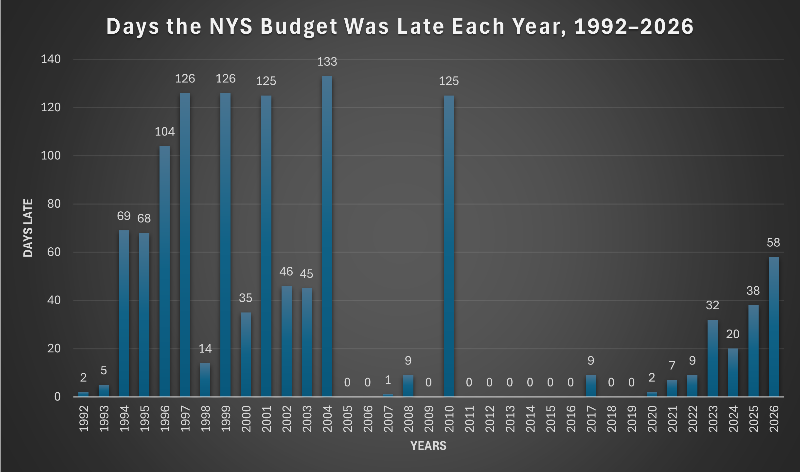
On Wednesday night, the Assembly finished passing the FY2027 Enacted Budget, with the Senate finishing later, roughly 40 minutes before midnight, nearly two months after the April 1st deadline. Although this year’s Budget was the latest in recent legislative history, it was still earlier than 1996 (104 days),1997 (126 days),1999 (126 days),2001’s “Barebones Budget” (125 days),2004 (133 days),and 2010 (125 days). However, with this year being an election year, the Legislature is scheduled to officially adjourn next week on June 4th, leaving lawmakers with only five legislative session days (including today and excluding June 5th, when lawmakers may convene for session) to pass their local and statewide legislative priorities.
Created by Aung Hset/D&A
Assemblymember John McDonald explained that although the Legislature has historically managed to “move many bills that are important to individuals, communities and New Yorkers,” the current “compressed time frame will prevent bills that require debate from making it to the floor for consideration.” “That is a byproduct of this legislative session,” McDonald added. While former Governor Andrew Cuomo has prioritized passing and enacting the Budget on time during his tenure, he also strengthened the Governor’s authority over the Budget process set by Silver v. Pataki by prioritizing policy items in the Executive Budget and 30-day Amendments. After Hochul succeeded Cuomo, many lawmakers and observers noted her insistence on including policy items in the Final Budget before fiscal discussions could start.
Assembly Speaker Carl Heastie, while reiterating his cordial relationship with Hochul, has publicly criticized the current budget process since 2022, previously explaining that “There’s something fundamentally wrong with this process.” Heastie and other lawmakers have reiterated that Hochul is simply exercising her authority under the 1927 constitutional amendment that established executive budgeting and the precedent set by Silver v. Pataki. Additionally, lawmakers have criticized the fact that they are prohibited from being paid if the Budget is delayed, but Hochul is not. “The strain of not getting a paycheck and the way this has been dragged out makes me feel like I’m being bullied into passing a budget I’m not fully happy with,” explained Assemblymember Diana Moreno. Notably, Heastie introduced a bill last year that would revert that prohibition if the Budget is delayed due to the Governor submitting “certain legislation which is not necessary for the effective implementation of the appropriation” bills.
Although some lawmakers have floated the idea of passing a constitutional amendment that would change the current budget process, Heastie explained that “it would be a huge endeavor to undertake because it would be a campaign [between] the Legislature and the Governor. Notably, the Legislature did attempt to change the process in 2005 after setting the record for the latest the Budget was late the year before but was rejected by voters by a margin of over 30%. While it remains to be seen if the Legislature will act next year to change the process, with Heastie previously saying, “I’m never doing this again. Budgets are supposed to be about money, not policy," Hochul has defended the process. “I’m using the procedure which has been in place for many years, it’s not something that I came up with. If the Budget is the only way I have to do it, I’m going to keep doing it,” Hochul said earlier this month
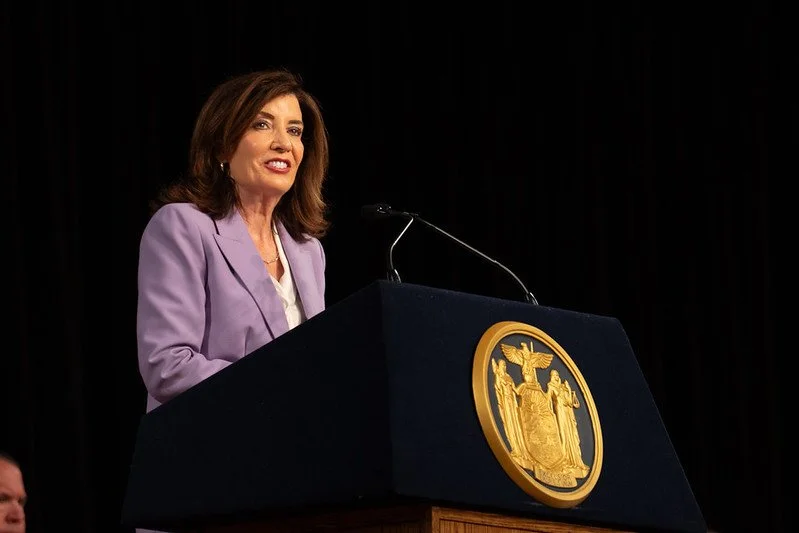
Aidin Bharti/Office of Governor Kathy Hochul
EXECUTIVE UPDATES
On Wednesday, Hochul joined a small business to tout her success in including a package of car insurance reforms in the FY2027 Enacted Budget to lower premiums and crack down on fraud, after months of negotiation with lawmakers. Under the package, penalties for staged accidents and insurance fraud will be strengthened, new tort restrictions will be implemented, state oversight of premium increases will be strengthened, and restrictions will be placed on what factors insurers could use to set rates. Under the included package, Hochul touts that policyholders could see a premium reduction of about 10% over time. The car insurance reform package complements Hochul’s priority of addressing affordability, as families in the state pay some of the highest car insurance premiums in the country, in part due to frivolous litigation and staged accidents. “Outdated laws, special interest loopholes and jackpot insurance payouts to bad actors have long forced New Yorkers to pay some of the highest car insurance rates in the nation. These hard-fought reforms are a win for every New Yorker who depends on a car to go to work or drop their kids at school,” explained Hochul.
Additionally, Hochul touted the inclusion of her priority to reform SEQRA in the Enacted Budget. Part of her Let Them Build agenda, the reforms will streamline the state’s environmental review process, establish clearer timelines for project approvals, reduce duplicative reviews, and create exemptions for certain infill and environmentally beneficial housing projects, while simultaneously ensuring appropriate environmental protection for certain areas. The reforms are expected to complement Hochul’s $25 billion Housing Plan to create or preserve 100,000 affordable housing units, as well as support the state’s priority of expanding the housing supply. “Red tape and duplicative reviews have stopped New York from doing the very building that made us the envy of the world, making our housing more expensive and our infrastructure outdated – that ends today,” said Hochul.
In anticipation of the summer, Hochul announced the start of construction of a revitalization of Denny Farrell Riverbank State Park in Manhattan. The $6.25 million revitalization project for the most visited state park in NYC is expected to finish in time for the summer season and will include renovated locker rooms, resurfaced athletic fields and track facilities, enhanced lighting, and upgrades to recreational and performing arts spaces aimed at improving accessibility, safety, and year-round community use. The project builds on the state’s commitment to modernizing state parks and expanding access to outdoor recreation. “Earlier this year, I committed to the renewal of this park as an investment in the health of New Yorkers, the strength of our communities and the special place that has become a cornerstone of the Harlem community over the past 30 years,” explained Hochul.
Earlier this week, Hochul announced the construction of an 187-unit mixed-use housing development in Poughkeepsie. The $147 million Wallace Campus located on Main Street is expected to bring affordable apartments with on-site supportive services for residents experiencing or at risk of being unhoused, as well as incorporating energy-efficient design features to advance the state’s energy goals. The development will be reserved for households earning up to 80 percent of the Area Median Income. The development supports Hochul’s $25 billion Housing Plan to create or preserve 100,000 affordable homes statewide. Currently, more than 9,000 affordable homes in the Hudson Valley have been created or preserved. “Wallace Campus will not only create new affordable housing opportunities on Poughkeepsie’s Main Street Corridor, but will also bring new economic activity to the city and preserve an important piece of Poughkeepsie’s history,” explained Hochul.
On Tuesday, in celebration of May as National Small Business Month, Hochul touted the state’s investment of more than $1 billion in capital deployed to small businesses throughout the state. Through direct investments, initiatives, state programs including ESD’s Main Street Capital Loan Fund, and prioritization of supporting MWBEs, Hochul reiterated that the state remains committed to supporting small businesses, easing their financial burden, and supporting new emerging advanced technology businesses, including biomedical, AI, and semiconductors. Specifically regarding MWBEs, Hochul explained that the state has a 31.86% MWBE utilization rate. “More than $1 billion in capital deployed, a record MWBE utilization rate and new rounds of innovation grants opening doors for entrepreneurs across every region of the state. This is what our small businesses deserve, and we will keep delivering,” explained Hochul.

LEGISLATIVE UPDATES
Next week is the last week of scheduled session days.
The Legislature is scheduled to be in session Monday to Thursday (and probably into Friday and Saturday)
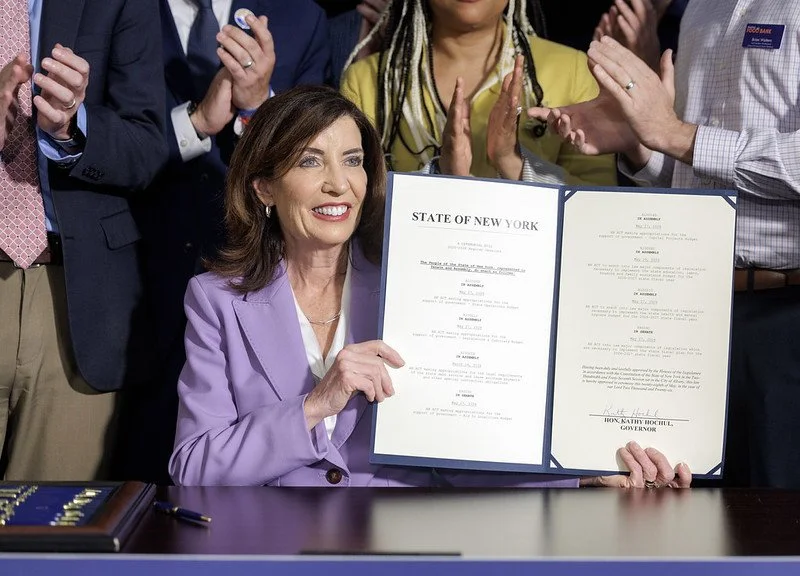
Mike Groll/Office of Governor Kathy Hochul
The "Big Ugly" TED Bill
In the “Big Ugly” Transportation Economic Development (TED)Budget bill, lawmakers approved various measures,, from addressing auto insurance premiums to SEQRA reforms, buffer zones, Tier 6 reforms, and CLCPA changes.
In Part EE, lawmakers approved changes to comparative negligence, the removal of the 90/180 days rule from the definition of “serious injury,” and a prohibition on litigation payouts if plaintiffs are found to be at fault for more than 50%. While Hochul was strongly advocating for the inclusion of this provision in the Budget to address insurance fraud and rising auto premiums, most lawmakers strongly opposed the proposals. However, the Legislature was able to include Part KK, which will require auto insurers to credit policyholders for their share of excess profit.
In Part VV, lawmakers approved Hochul’s proposal to amend the state’s CLCPA, with changes to how emissions are calculated and regulation deadlines. Under the changes, the state will now measure GHG emissions over a 100-year timeframe instead of a 20-year timeframe, and will extend the original deadline until 2028 for when regulations must be promulgated to meet a 60% reduction in emissions by 2040. While lawmakers approved the changes, many still criticized Hochul for proposing the changes, with Assemblymember Dr. Anna Kelles saying, “We are watching New York become the first state in the country to roll back its climate laws. It’s disappointing and embarrassing.”
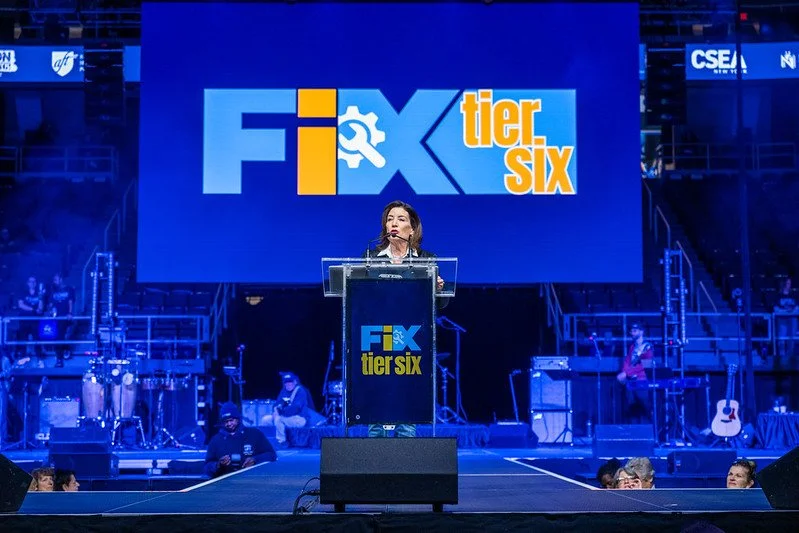
Aung Hset/D&A
In Part XX, lawmakers approved reforming Tier 6, which will now allow covered employees to retire at age 58 after 30 years of service, as well as lowering their employee contribution from 3% to 5.75%. First established in 2012 to save state and local governments money, unions have since been advocating for its repeal alongside many lawmakers. It is estimated that the reform will cost $557 million, with $118 million for the state and $440 million for local governments.
Other notable provisions of TED include:
Part D: NYC Super Speeder Law
Part R: SEQRA Reforms
Part Y: Safe by Design Act
Part HHH: Increasing the Number of NYC Civil Court Judges
Health and Mental Hygiene Bill
In the Health and Mental Hygiene Budget bill (HMH), lawmakers approved various measures to ensure maximum access to healthcare. However, the HMH Budget bill failed to include any provisions to help recapture the roughly 400,000 individuals set to lose Essential Plan coverage in the summer, confirming comments made by Heastie last week.
One controversial issue approved by lawmakers is reforming the state’s independent dispute resolution process (Part BB), which governs how surprise billing disputes between doctors and insurance companies are resolved. Under the changes, it would exclude Medicaid from the process and set pricing benchmarks for the state employee health plans. It is expected that the reforms will save roughly $57 million.
Notably, the Budget bill included a provision allowing the state to continue operating a tax on managed care organizations (Part Y). Currently, the state’s existing tax is set to expire by the end of the year due to HR.1; however, with the newly approved provision, the state will be allowed to ask the federal government to continue operating the tax under a different structure and at a lower rate. While the new tax will help the state raise additional revenue, it is expected to be much lower than the current structure.
Other notable provisions of HMH include:
Part F: Medicaid Lookback Window for Home Healthcare
Part L: 5% Cut in Medicaid Capital Funding
Part R: Health Insurance Coverage for “Substance-Related and Addictive Disorder Services”
Revenue Bill
For the Revenue Budget bill (REV), the Legislature agreed to Hochul’s commitment not to increase personal income taxes. However, the Budget bill did include a new NYC pied-à-terre tax, a ZYN tax, and an extension of current corporate tax rates until 2030.
Under the newly approved pied-à-terre tax (Part HH), the state officially authorized NYC to impose a surcharge on second homes valued at more than $5 million or $1 million for condos and co-ops. Specifically, properties worth $1 million and $3 million are taxed at an annual 4% rate, while properties worth between $3 million and $5 million are taxed at an annual 5.25% rate. Properties worth more than $5 million can be taxed at 6.5%. However, NYC is expected to gradually update the valuations resulting in tax rate of 0.8% for properties worth between $5 million and $15 million, 1.05% for properties worth between $15 million and $25 million will be taxed at 1.05%, and 1.3% for properties worth over $25 million after the valuation adjustments.
Today, I voted NO on Hochul's revenue budget bill that failed to sufficiently tax the rich or protect New Yorkers from federal cuts.
— Diana Moreno (@DianaforQueens) May 28, 2026
The pied-à-terre tax that our movement won is a start, but it is not enough. The fight for dignity and justice for working New Yorkers continues. pic.twitter.com/gXCT4mX8DP
Although the pied-à-terre tax was included in the Enacted Budget, many lawmakers still criticized Hochul for not agreeing to furrther increase taxes on the rich. While NYC Mayor Zohran Mamdani praised Hochul for the new pied-à-terre tax, some lawmakers, including Assemblymember Diana Moreno, voted against the budget, explaining that the Enacted Budget ignores “the vast majority of New Yorkers who wanted to increase taxes on the ultra-wealthy.”
Other notable provisions in the REV Budget Bill include:
Part B: No Tax on Tips Up to $25,000
Part E: Extending Current Corporate Tax Rate Until 2030
Part K: The ZYN Tax
Part FF: Energy Rebate Checks
Appropriation Bills
In total, this year’s Enacted Budget amounted to $268.5 billion without any additional income tax or corporate tax rate increases. With the $440 million price tag for local governments due to Tier 6 reforms and the existing budget deficit across various cities, the Enacted Budget appropriated tens of millions of dollars for them. In total, roughly $55 million for Buffalo, $40 million for Albany and Yonkers, $20 million for Rochester and Syracuse, $10 million for Mount Vernon, and nearly $700 million for NYC. To address the federal cuts in healthcare spending and aid, the Enacted Budget allocated $1.5 billion for hospitals and nursing homes, including $706 million in inpatient and outpatient rate investments and $480 million for nursing homes. Hospitals are also receiving $94 million to restore their capital rate and reconciliation cut partially, and $250 million to restore their quality pool.
Other notable appropriations include:
$250 million for Raise the Age
$83.8 million for Council on the Arts Program
$6.6 million for the Green Thumb Program
$1 billion for the Sustainable Future Program
Aung Hset/D&A
Enacted Budget Includes 50ft Buffer Zones
One notable bill that the Enacted Budget included is the 50ft buffer zones around centers of worship. Specifically, the provision will allow local law enforcement to create a 50-foot “security perimeter” around a place of worship and to establish a new crime of “criminal interference with access to a place of religious worship.” Advocated by Hochul and some lawmakers, the bill is seen as a measure against increasing rates of antisemitism and in response to pro-Palestinian protests. “As we're witnessing an alarming rise in hate-fueled attacks and blatant antisemitism, I'm grateful my buffer zones legislation has passed, and New Yorkers will be safer because of it,” said Hochul. Recently, Mayor Zohran Mamdani vetoed a similar Council bill that would allow the NYPD to create 50-foot buffer zones around schools and educational buildings. While NYC Council Speaker Julie Menin did not move to override the veto, she previously said she will introduce a new bill that would only create buffer zones around educational buildings.
Chatbots shouldn’t claim to be a doctor, lawyer or any other licensed professional. My bill, S7263, stops chatbots from impersonating licensed professions while allowing those bots to still give advice. Here’s a thread on what the bill does/doesn’t do & why it’s important:🧵(1/6) https://t.co/5LF46gp70u
— NY State Senator Kristen Gonzalez (@SenGonzalezNY) March 6, 2026
Senator Gonzalez and Assemblymember Zaccaro Looking to Pass AI Chatbot Bill
With very limited time before session officially adjourns next week, Senate Technology Chair Kristen Gonzalez and Assemblymember John Zaccaro reiterated their commitment to passing their bill that would impose liability for damages caused by a chatbot impersonating certain licensed professions, including attorneys and medical practitioners. If passed and enacted, it would be the first-in-the-nation regulation that lawmakers and advocates argue is essential to ensuring broader accountability and transparency, as well as protecting public safety. As part of a broader AI legislative package Gonzalez is advocating for, she explained, “We have documented instances of AI chatbots providing false medical license numbers to users and documented cases of real harm from AI chatbots providing misinformation. This is what my common-sense legislation addresses—protecting users from misinformation, scams, and fraud.” Earlier today, the bill moved through the Assembly Codes Committee, with some observers expecting it to also pass the Senate.
OTHER UPDATES
A State Appellate Court Sides with Bruce Blakeman Over Public Campaign Finance Board
Yesterday, a state appellate court ruled that the state Public Campaign Finance Board's handling of the new matching funds rollout was “irrational” and ordered the state to allow GOP gubernatorial candidate Bruce Blakeman to cure his defects in the forms that the Board never appropriately explained. The appellate court’s ruling comes after a state Supreme Court judge also ruled in favor of Blakeman in a lawsuit he filed, which was then subsequently appealed by the Democratic-appointed members of the Board. With the ruling, Blakeman may be able to get his public matching funds, which the Board previously denied in March due to improper filings of certain documents. “I am very grateful that the trial court and the appellate court saw through this scam to keep me and [Lt. Gov. candidate] Tom Hodd from getting our matching funds,” said Blakeman.
This morning we are introducing COGE — the Commission on Government Efficiency.
— Mayor Zohran Kwame Mamdani (@NYCMayor) May 28, 2026
This Commission will find ways for our city to work smarter, faster, and more effectively for working people.
New Yorkers deserve a city government as careful with their money as they are.
Mamdani Announces COGE After Dismantling Eric Adams-era Charter Commission
After getting approval from the Legislature in the Enacted Budget, NYC Mayor Zohran Mamdani moved to disband a city charter revision commission established by former Mayor Eric Adams. Additionally, Mamdani convened a new charter revision commission, the Commission on Government Efficiency, or COGE. Mamdani explained that the new Commission will “examine how the New York City Charter can better support public excellence by improving efficiency, modernizing city government, and ensuring government keeps pace with New Yorkers’ needs.” Before its recommendations are put to a vote in November, the Commission will hold 10 public hearings across NYC. However, it remains to be seen if the members of the dismantled Commission will sue Mamdani.
Other Interesting Friday Reads
This Budget Truly Addresses the Affordability Crisis - EMPIRE REPORT NEW YORK 2026® NEW YORK'S 24/7 NEWS SITE
For Kathy Hochul, a late budget isn’t a problem – it’s a successful tactic - City & State New York
NYCLU's lawsuit against Nassau pits free speech against religious freedom - Newsday
Hochul knocks Trump’s ‘slush fund’ - POLITICO
North Country Farmer Seeks to End Decade of GOP Dominance in NY-21 – The Legislative Gazette
NY7 candidates mostly support Sunnyside Yard plan – even if Trump is involved — Queens Daily Eagle
A frustrated Staten Island lawmaker says NYC's dual voting systems are warping elections — and he's pushing a fix - silive.com
Is the Port Authority Bus Terminal actually a hidden gem? - Gothamist
Mamdani Vowed to Back Espaillat. Now He’s Endorsing a D.S.A. Challenger. - The New York Times
Read Past Issues of the Brief
here is another blog